Thursday, 29 January 2015

Mine Mayhem!

Another Maths Game to play!
Have a go at the multiples, as well as looking at the simplifying fractions and prime numbers too!
 

Maths Rap!

 
You all seemed to really enjoy this maths rap... perhaps you'd like to practise it a bit more at home...!

Setting the scene.


Think about a place in your mythical story, this might be a forest, cave or castle. Imagine how your character feels as they enter this mysterious place. Write a short paragraph including:

·         Description of how your character moves.

·         What your character can see.

·         Adverbs to show how they are moving eg. Crept cautiously.

·         Anything they can hear, smell or touch.


I look forward to reading your blog entries, either on paper or on here!

Friday, 16 January 2015

Lord Voldemath...

Some of you were interested in playing this game to carry on practising your calculations! 
 
Here's the link!


Speech

Write a conversation between two characters from Brave Rowland. Remember to use:

·         Speech marks around the words which are said.

·         Punctuation inside the speech marks.

·         A new line for each new speaker.

·         A comma to separate the speech and narrative.

·         Alternatives for said.


I look forward to reading your blog entries by Friday 23rd January!

Sunday, 11 January 2015

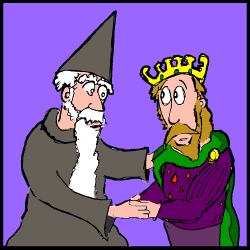
Brave Rowland!

Our new literacy topic is ‘Stories with mythical creatures or events’. This week we have been learning the story of Brave Rowland. For your homework this week, write the first two chapters of the story. Use the story map as a reminder!
Remember to include:
Capital letters and full stops
Fronted adverbials
Speech
description


Friday, 21 November 2014

How Does a Tigon Catch Its Prey?

Pick one of your cross breed animals from last week’s homework. Then write a short explanation text about it with two paragraphs.

Paragraph 1: introduction. What is your animal called, what does it look like? What does it eat?

Paragraph 2: How does this animal catch its prey? (This is the bit which explains the 'how' and 'why')

For example:

How Does a Tigon catches Its Prey?

Tigons are a cross between a female lion and a male tiger. Unlike ligers, which are also a cross breed, tigons are much smaller than a lion or tiger. Tigons have four legs, a long tail and powerful claws. Interestingly, they also have a spotted and striped coat and a small mane similar to a lions.
Tigons, like lions and tigers, eat meat. First they hide in order to sneak up on their prey. Then they slowly approach the prey until they are within striking distance. When ready the tigon will leap at the prey, usually from behind, and sink its teeth into the animals flesh. The tigon will then drag its prey away to a safe place to feed on it.

As always, you need to think about sentences (think, say, write), spellings and making your writing interesting!

I look forward to reading your explanations!

Monday, 17 November 2014

Lion and Tiger Cross Cubs

Three unusual looking cubs have been born to a tiger mum and lion dad at a zoo in Germany.

Called ligers, the cubs have spots AND stripes on their coats and are thought to be the largest cats in the world.

One of the cubs died shortly after it was born, but the other two are said to be doing really well and are enjoying their new-found celebrity.

It is unusual for different species of animals to have babies together so liger cubs are very rare.

 
Even rarer are tigons, which are born to a lion mum and tiger dad. Unlike ligers, tigons are often much smaller than either of their parents.


Homework task;

If you could mix any two animals what would they be? 

What would you call the new animal?

What would it be like?

Where would it live?

What would it eat?

 
Write about your new animal using full paragraphs and extended sentences.

Please submit your writing, either via the blog or on paper, on Friday 21st November 2014

Mrs Messa

Tuesday, 28 October 2014

Half-Term Writing!


This term we have been learning about the Ancient Egyptians with a particular focus on transport and communication.  Your homework is to write a non-chronological report about the Ancient Egyptians.  You can include any information you have learnt about the Ancient Egyptians.  Think about how you will organise the information.  You may include the following paragraphs:
 
The Rosetta Stone
Heiroglyphs
Egyptian Ships
The Nile
 
Try and include the features of a non-chronological report that you have learnt about!
 
Remember, 'think, say, write, check'!
 
Mrs Messa


Friday, 3 October 2014

The Human Body!

The Digestive System

 
Over the next few weeks we will be writing non-chronological reports about the digestive system, which is our science topic.
For your homework, please research the organs of the digestive system and the journey food takes through our bodies.
Write some of your research onto the blog so that we have a shared resource when we come to write our reports!
Check your sentences and spellings very carefully. 
Remember: 'think, say, write, check'!
You need to post on the blog or give me your homework on paper by Friday 10th October!
 
Mrs Messa